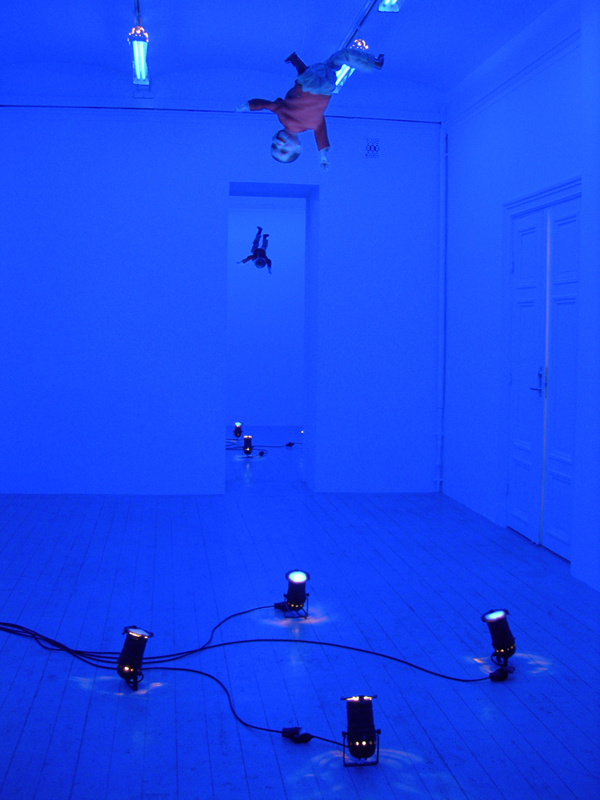
In Feingold’s installation there is an ongoing conversation between the two puppets where the focus is set on the tension between them. They are discussing, or perhaps singing, refrains about their relations with phrases such as "You make me so crazy" and "You make me feel so good" to the more erotic where they exchange their desires.
So you make me so crazy
Once I said so
You just are so hard to know so
I should not want to have to have you
So I could have to have you so
I need you so
You need me to want to have you
So I could always have you when I want you so
When I want to kill you, you want me so
You make me so crazy
"The dialog is not recorded but generated in real time by a computer running a program written by Feingold that examines the text just spoken and, according to algorithms, draws upon databases of words and syntaxes to create the lyrics. The song of the puppets is in this way neither scripted nor fully random; at the same time it is constantly changing. Even if the puppets follow each other there is a dysfunction in the communication which interests Feingold, and in his pieces he returns to situations where communication fails, when words lose their meaning, and where the parts go from an engaged conversation to setting themselves on "automatic."
"For Mejan Labs Ken Feingold premiered a new work in his Eros and Thanatos series, titled Eros and Thanatos Falling/Flying. Here he suspends two ventriloquist puppets, one in each room of Mejan Labs, from the ceiling so they appear to fly or fall. This ambivalence, a balance between two opposites, is something found in several of Feingold’s pieces. The mythical characters of Eros and Thanatos were used by Freud in his formulation of drive theory to metaphorically represent the fundamental biological energies of Eros (life, creativity, growth, tension) and Thanatos (homeostasis, negation, dissolution, death). Psychoanalysts who follow Freud’s ideas agree that we are constantly driven between stimulation and action by a balance of these forces."