click images for larger versions
At the center of my work Childhood / Hot & Cold Wars (The Appearance of Nature), I have undertaken a search for my childhood TV memories, a kind of archeology of those images and sounds which I remember, or see now, as having been formative in my personal understanding of what was going on in the world.
I grew up watching television. Some of my earliest and most vivid sensory and emotional memories are of television programs I saw in my first years. The themes of my childhood emerged amid ever-present references to World War III, the atom bomb, the Communist Threat and the Domino Theory, intersected by the emergence of suburbia, Sputnik, the Space Race and promises of endless progress in a fantastic technological future in which I would be visiting other worlds. These recurring themes were played out through TV characters, news, advertisements, science fiction films, children's programs, and Civil Defense films – a strange mixture of cartoon violence, sci-fi monsters, cowboys and Indians, and air raid drills – in which we spoke with equal ease of Nazis, Communists, the end of the world, aliens and space-stations.
We only had to say or hear the names Hiroshima and Nagasaki, Auschwitz or Dachau to feel a surge of fear, and a thrill at being the winners of that war. In school and at home, we practiced for nuclear attack, and watched people, monsters and cartoon animals killing each other on TV. It seemed natural, the way things were.
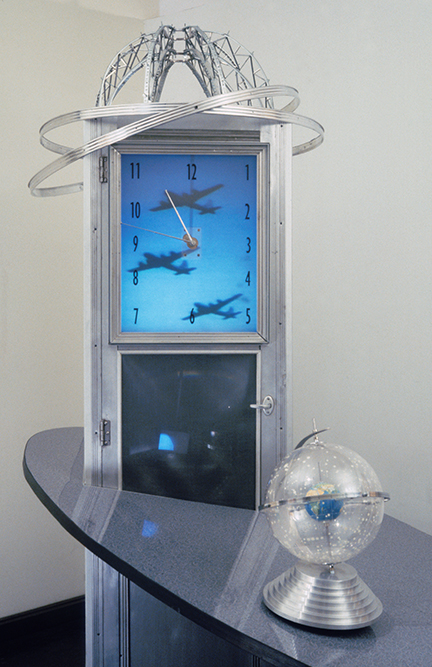
The work is a complex, hybrid object; it has aspects of a grandfather clock intersected by a Formica dining table, parts of a suburban tract house, and the roof is a replica of the Hiroshima building called the A-bomb Dome, a surviving skeleton that now stands as a memorial. The object is made primarily of aluminum, approximately seven feet high.
The face of the clock has numbers and hands as an ordinary clock, but this face is also a screen upon which the video images are rear-projected from within the body of the clock. The front of the clock body is a typical 1950s screen door (also referring to the TV/cinema screen, and screen memories – so important to this work), made from the actual door of my parents' home.
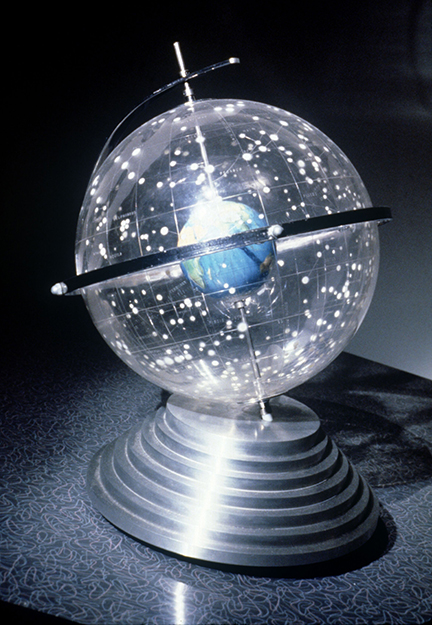
Intersecting the body of the clock is a skewed dining table. On it sits a globe – a transparent celestial globe mapping the heavens, with a smaller earth globe within it. Behind the globe, below the clock-face, is a window through which a small tele-pendulum marks seconds with each swing. Standing alone, the work plays these TV fragments as if ticking on the clock face, one field per second; it takes 24 hours to play its full cycle.
The work has interactive aspects. A viewer who becomes physically involved with the work – by turning the globe – affects the ways in which the TV images and sounds are played, and may move through them forward and back in time. The circuits and software I made respond to gestures rather than treating the globe simply as a trackball.
-kf 1993
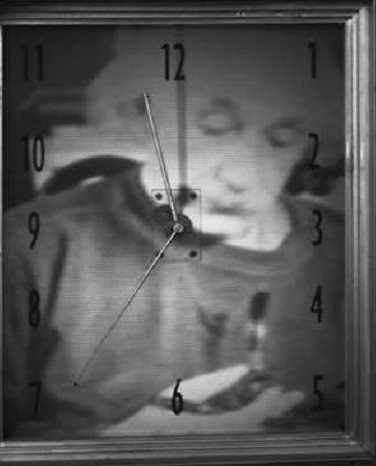
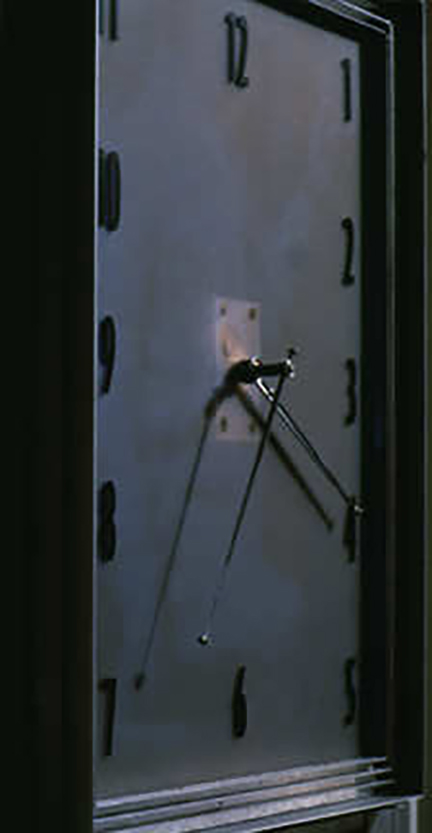
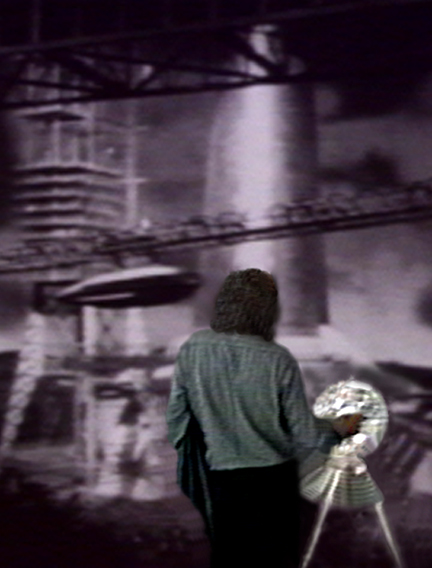
l to r: screen detail; clock hands detail; free space version
exhibition history:
Memorial Art Gallery, Rochester, NY; Montage’93, 1993
International Center of Photography (ICP Midtown), New York; Iterations, 1993
Interactive Media Festival, Los Angeles, 1994
Biennale de Art Contemporain de Lyon; 1995–96
Ken Feingold |
artworks |
catalog |
reference texts |
contacts
copyright © 1998–2025 all rights reserved